.png?width=300&height=69&name=Logo%20SmartGuide%20horizontal%20(1).png "SmartGuide")
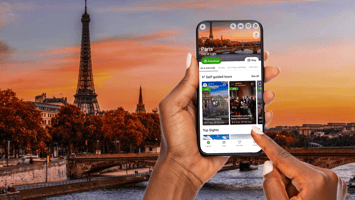
Travelers today crave authenticity, engagement, and convenience. The era of static brochures has...
Travelers today expect digital guidance that is practical, engaging, and easy to access. Static brochures, printed maps, or outdated audio tools are no longer enough. Modern audience prefers mobile-first solutions that offer real-time support, cultural context, and interactive features before and during their trip.
Tour guide apps have become a key method for destinations, museums, attractions, and tourism boards to directly connect with visitors, helping them explore with greater confidence and relevance. However, with so many apps available, the real challenge lies in choosing the right platform to publish your destination guide.
This blog post highlights the best tour guide apps and platforms for publishing a tour guide in 2026. Each platform is carefully selected based on usability, audience reach, and suitability for tourism content, helping you showcase your destination effectively and meet modern traveler expectations.

Image downloaded from iStock
1) SmartGuide
SmartGuide is the world’s leading digital audio guide platform with self-guided tours available in 1,600+ destinations worldwide. It provides a complete solution for destinations, attractions, travel businesses, and independent tour guides to create high-quality digital guides efficiently. Whether the goal is to design a walking tour (indoors or outdoors) or a route by bike, boat, car, or bus, SmartGuide enables content creators to deliver guides tailored to visitor preferences.
Using SmartGuide’s open, AI-powered self-service content management system (CMS), creators can build professional guides in just a few hours. The platform makes it easy to adapt the content to different audience groups and design targeted visitor journeys.
The CMS includes an automatic text-to-speech (TTS) engine with three audio delivery options:
-
TTS (free): Instantly converts text to speech, ideal for quick updates
-
TTS with phonemes (paid): Improves pronunciation, especially for foreign names and acronyms
-
Human voice recordings: Voice actor-produced audio for deeper expression
Additionally, DeepL translation is built into the CMS, allowing tours to be translated into multiple languages with just a click.
SmartGuide also demonstrates how AI can streamline travel guide production. Its proprietary SmartGuide AI model, based on ChatGPT-4o and supported by other AI agents, produces engaging and fact-checked guide content in various styles, including more playful or character-driven versions. By helping destinations develop custom content more quickly and guide visitors across less-visited areas, SmartGuide also supports more sustainable tourism efforts.
.png?width=598&height=502&name=SMG%20device%20screen%20templates%20(84).png)
SmartGuide digital audio guide app
Beyond audio and video, the platform supports augmented reality (AR)-enhanced tours, allowing creators to add AR elements to their guides. Even without detailed 3D models, using historical photos overlaid on present-day scenes via AR can significantly boost engagement. SmartGuide has also launched an AI chatbot within the app to provide real-time assistance and personalized itineraries.
SmartGuide goes beyond content creation — it also offers advanced analytics features, including big data dashboards, GPS heatmaps with meter-level accuracy, and expert data interpretation. Destinations can access insights into visitor demographics, acquisition channels, and the most popular tour sections or points of interest.
While the SmartGuide team is available for professional content production support, creators can design and publish guides independently, completely free of charge.
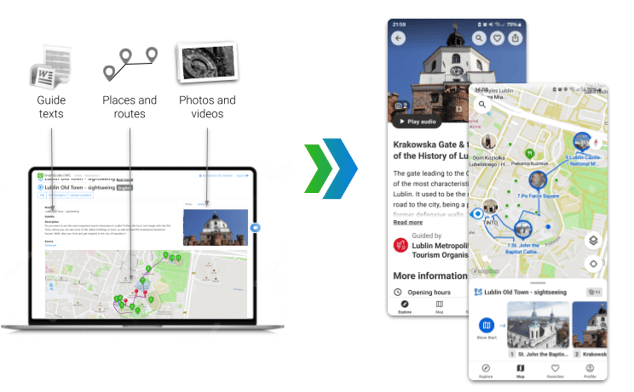
SmartGuide’s AI-powered CMS allows content creators to rapidly build customized guides, offering features such as automatic text-to-speech, improved pronunciation options, professional voice recordings, and one-click DeepL translations to reach diverse audiences.
Pros
- Covers over 100,000 locations worldwide, making it one of the most comprehensive digital guide platforms.
- Guides can be created in 102 languages, including Chinese, French, German, Spanish, English, Hindi, Slovak, Croatian, Italian, Japanese, Portuguese, Russian, Afrikaans, Dutch, and Finnish.
- Free AI-powered CMS enables automatic translation into +30 languages and text-to-speech conversion, simplifying content localization for diverse audiences.
- Supports augmented reality experiences, enhancing visitor engagement with AR overlays and historical visuals.
- Offers flexible distribution options to sell guides.
- Big data dashboards, heatmaps, and expert analytics provide insights on visitor demographics, popular tours or points of interest, acquisition channels, and content gaps.
- Offers destination marketing support and expert consultations, helping tourism entities promote their attractions effectively.
- Businesses can advertise services through POI (Point of Interest) Advertising, reaching visitors directly in the app.
- SmartGuide uses a sophisticated AI model to provide personalized recommendations based on user interests, improving tailored experiences while encouraging sustainable tourism by dispersing visitor traffic.
- Features an AI itinerary planner, enabling app users to design custom tours and interactive experiences quickly.

Cons
- While it currently supports certain integrations such as GetYourGuide ticket sales, the number of integrations is on the lower side. However, more are being implemented to enhance functionality.
- The spread of content geographically is largely dependent on the preferences of the individual content creators, given that it's an open platform where anyone can create a digital travel guide.
- The app is not available on the Windows Phone Store.
2) izi. Travel
This audio guide platform offers 25000+ engaging tours for over 2500 cities worldwide, catering to professionals in the cultural and tourism sectors as well as passionate storytellers.
izi.TRAVEL stands out for its ease of use, requiring no special hardware, programming skills, or technical expertise to create content on its free content management system. Individuals can develop mobile tours or single-story experiences covering topics such as art, cuisine, lifestyle, shopping, and more. Trusted by museums, galleries, cities, and attractions globally, it provides an efficient solution for creating professional mobile multimedia guides.
The platform’s CMS allows content creators to manage text, audio, images, and videos, combining them into indoor guides, outdoor tours, or standalone stories. Updates to content, addition of new stories, or inclusion of multiple languages are all accomplished with just a few clicks, instantly reflecting for visitors. Content authors can control access to their content, remove it, or share it across multiple channels as needed.
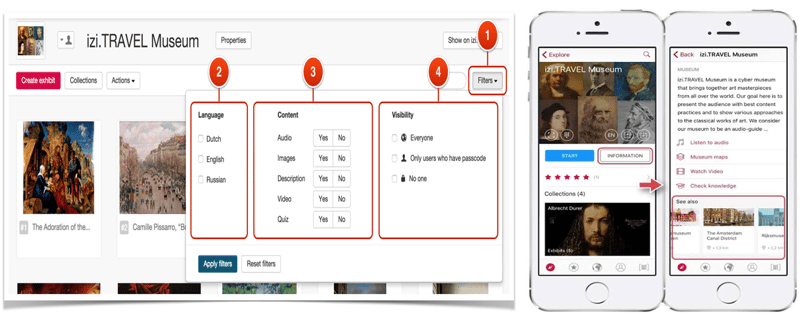
Source: https://izi.travel/en
Designed to be fully self-sufficient, izi.TRAVEL requires no maintenance costs. Guides can go live within hours without relying on external support. Content creators also gain access to analytics on engagement, such as visit counts and audio playbacks, to better understand how audiences interact with their content.
Additionally, the free izi.TRAVEL API integrates mobile, web, and social technologies to offer a comprehensive solution for interactive guide creation. The API provides endpoints to access city tours and audio guides, enabling developers to distribute content through their own channels. It supports various applications, including car infotainment systems with guided tours, navigation apps featuring stories along routes, and local Wi-Fi systems on buses or airplanes, making it possible to deliver curated tours to travelers globally.
Pros
- Audio tours are available across 137 countries in 50 languages, ensuring broad accessibility for international users.
- Offers an API that allows developers and organizations to access its content and integrate it into their own applications or platforms. This enables the dissemination of izi.TRAVEL's audio tours and cultural content through various channels.
- The Visits Statistics tool within the izi.TRAVEL CMS desktop provides valuable insights into how frequently visitors listen to a creator’s audio guides. It tracks metrics such as content type engagement, completion reasons, activation mode, and access method, helping guide authors refine their content based on user behavior.
- The official izi.TRAVEL website explicitly promotes the app with a direct download link from the "Windows phone store," alongside iOS App Store and Google Play options
Cons
- Does not currently support advanced AI-driven functionality and AR-based enhancements.
- Does not provide personalized recommendations tailored to visitors' interests or past behavior.
- No complex regional tours.
3) GuidePal
GuidePal is a creator-driven mobile app that enables individuals to earn money by recommending their favorite places and activities directly to their followers—without relying on brands or advertisers. Creators have complete freedom to design guides on any topic and in any style, using text, photos, videos, quotes, audio recordings, and maps. Each guide contains up to 15 recommendations.
Every guide on the platform is available for a fixed price of $1.99, making it accessible for users while ensuring fair compensation for creators. Earnings are split each month transparently: 70% goes to the creator and 30% to GuidePal. Creators can also donate some or all of their revenue to a nonprofit of their choice, and guides that include charitable contributions receive special badges to help them stand out to socially minded users.
Getting started is simple. After creating a guide and adding optional donation settings, the creator publishes it and shares a preview link on social media. Followers can unlock the full guide for $1.99, and creators can track sales and payouts through the in-app Insights tab. GuidePal manages the transaction process, ensuring monthly earnings are delivered on time.
The platform also supports travel organizers looking to share itineraries and curated recommendations with their customers, and advertisers who want professionally produced branded content. Dedicated dashboards help creators and partners manage their guides, update itineraries, communicate with travelers, review analytics, and store saved guides or recommendations.
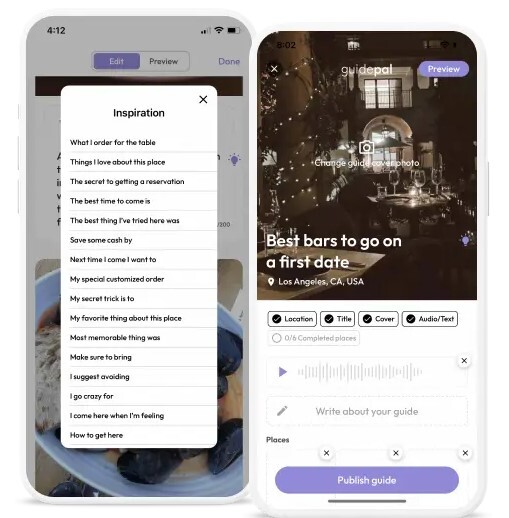
Source: https://www.guidepal.com/
Pros
- Transparent creator earnings model with a clear 70/30 revenue split and monthly payouts.
- A charitable donation feature that lets creators direct part or all of their earnings to nonprofits, with special badges highlighting donation-supported guides.
- Flexible guide creation options, supporting text, images, audio, video, and maps—ideal for niche, thematic, or personality-driven content.
- Opportunities for paid collaborations, including GuidePal’s creator network, where creators can produce guides for travel organizers or brands.
- Support for advertisers, offering end-to-end proposals including guide concepts, recommended creators, and projected reach.
- Dashboards for both creators and travel organizers, enabling guide editing, itinerary updates, user communication, and access to basic performance statistics.
- Affordable pricing for app users, with all guides available for $1.99.
Cons
- Does not offer advanced AI-powered tools such as AI itinerary planner, AI chatbot, automated content generation, or AI-based storytelling features.
- Lacks personalized recommendations tailored to user interests or behavior.
- Does not support complex or large-scale regional tours with detailed routing features.
- Limited destination management tools, such as deep analytics or visitor movement tracking.
- Does not include heatmaps and extensive data dashboards for tourism boards.
- The app is not available for Windows Phone.
4) Tourient
Tourient is a digital platform designed to help destinations, tourism organizations, and cultural institutions create interactive, self-guided experiences with ease. It supports unlimited tours in 64 languages, offers flexible audio options (voice actors, DIY recordings, or TTS), and allows full brand customization through custom colors, fonts, and visual accessibility settings. Visitors can enjoy adjustable audio controls, transcripts, and add-ons like 3D models (Matterport, Sketchfab), podcasts, playlists, and GIS-powered maps, making Tourient suitable for museums, attractions, campuses, and heritage sites. The audio player also operates in the background using the Media API, allowing visitors to listen with their phones in their pockets.
Beyond content creation, Tourient also helps organizations understand visitor engagement through detailed analytics. Content creators can track engagement, tour behavior, and even monitor sponsor clicks. The platform supports revenue-generating opportunities by letting institutions feature sponsors directly on the tour start page, add local ads in the map view, and display exclusive offers. With built-in tools like print-ready QR codes, social media graphics, and labels, it also simplifies marketing and visitor outreach.
The platform also supports quizzes, polls, analytics, and customizable end-of-tour calls to action, making it useful not only for visitor engagement but also for data collection, donor cultivation, and community interaction.
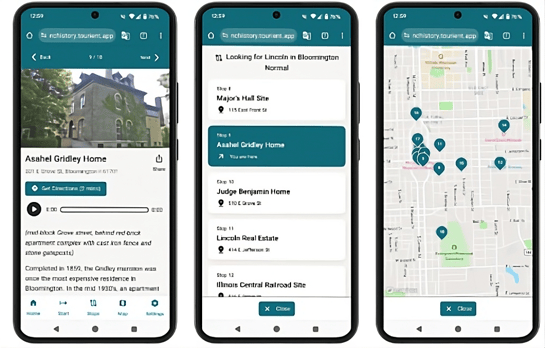
Source : https://tourient.app/
Pros
- Supports 64 interface languages and adds new ones upon request at no additional charge.
- Offers sponsor-friendly tools with ads, offers, click-tracking, and post-tour CTAs to boost funding and visitor engagement.
- Tourient provides support via phone, chat, text, email, and even postcards. Plus, they contribute 1.75% of revenue toward paid internship programs for small museums.
- Multiple staff members can edit simultaneously with granular permissions, making it easy for museums with large teams.
- Features wide multimedia support, including Podcasts, Music playlists even Spotify/Apple, 3D models (Matterport, Sketchfab), Oral histories through TheirStory, and GIS map layers.
- Offers strong built-in accessibility features like WCAG compliance and visual controls (dark/high mode, contrast settings, and adjustable text size), great for cultural organizations prioritizing accessibility compliance.
Cons
- Does not support AI-powered features such as AI tour planner, AI chatbot, and AI-powered personalized recommendations based on visitors' interests.
- Although Tourient has an easy drag-and-drop editor, it does not automate content creation with auto voiceover, auto translations, and auto route generation
- Tourient is designed mainly for standalone exhibits or institutions, not for broader destination visibility.
- Does not offer complex regional tours and cross-promotion benefits.
5) STORYHUNT
StoryHunt is a platform designed for destinations, attractions, tour operators, and storytellers who want to create self-guided tours that are intriguing and infused with authentic local narratives. Using the StoryHunt Creator content management system, users can easily map stories, add multimedia content, manage routes, and publish tours directly to the StoryHunt app and website. The interface supports text, audio, video, images, and quizzes, allowing creators to design layered, interactive experiences that deepen visitor engagement.
The platform offers strong collaboration features. Multiple creators can work on the same project simultaneously, and it provides integrated monetization tools, enabling monthly payouts from tour sales or bundled packages, such as food, drinks, or admission. StoryHunt also includes a partner distribution network, giving creators access to thousands of travelers through third-party channels, which helps increase tour visibility and revenue potential.
AI tools power much of the content creation workflow. Creators can use AI for script generation, automatic translations in all key languages, and natural-sounding voice output. StoryHunt also provides live statistics where users can monitor performance, understand visitor behavior, and use insights to improve experiences. With its easy map-based tour building and automatic route generation, the platform aims to make storytelling accessible—even for beginners.
.png)
Source: https://www.storyhunt.io/en
Pros
- Easy story mapping with automatic routing and drag-to-adjust controls.
- Multimedia-rich tours (text, audio, video, images) and interactive quizzes.
- Strong AI support for text generation, translations, and voiceovers.
- Built-in monetization with monthly payouts and package-deal support.
- Partner distribution network for broader reach.
- Collaborative creation features for teams.
- Live user statistics for engagement insights.
Cons
- No real-time AI assistant, AI tour planner, and AI-powered personalized recommendations based on visitors' profiles.
- Does not offer complex regional tours.
- Some advanced visitor experience tools (heatmaps, AR layers, indoor positioning) are missing.
- Monetization depends heavily on StoryHunt’s app ecosystem, not a fully white-label solution.
6) STQRY
STQRY (formerly OnCell) is a comprehensive no-code platform designed for destinations, attractions, museums, cultural institutions, and tourism businesses that want to build digital experiences without technical complexity. With STQRY Apps, organizations can turn their walking tours, stories, exhibitions, or audio guides into fully branded mobile apps and web apps that work seamlessly online and offline. The platform supports multimedia storytelling—including images, audio, text, videos, maps, 360° media, and AR—allowing creators to design interactive and deeply engaging visitor experiences.
The STQRY Builder, a simple web-based editor, lets users add content, customize layouts, manage routes, and update their app at any time. It supports geofenced alerts and iBeacons for triggering on-site content, making it ideal for wide-area tours, cities, and campus-style experiences. Users can publish their content as a custom iOS/Android app or distribute instantly through the STQRY Guide app with no setup required. The builder also supports advanced features such as multilingual interfaces (50+ languages), accessibility options, custom branding, and integration of indoor/outdoor maps—even custom GIS-based maps.
.png?width=452&height=358&name=STQRY%20Builder%20(2).png)
Source: https://stqry.com/
STQRY offers robust analytics to help destinations understand visitor behavior. Metrics include visits, screen views, average time on site, device usage, language usage, and engagement patterns. It also integrates with Google Analytics and app store dashboards for deeper insights into downloads, revenue (for in-app purchases), and audience demographics. STQRY supports kiosks through STQRY Collect, enabling onsite interactive screens for exhibitions and visitor centers—perfect for hybrid physical/digital storytelling. Additional functionality includes real-time content updates, admin-level user permissions, sponsorship/advertising tools, and support for background notifications.
Overall, STQRY positions itself as a scalable, flexible solution suited for single tours or large multi-site networks, offering ongoing customer support, frequent software updates, and a suite of tools for interactive, accessible, and data-driven visitor engagement.
Pros
- Creators can publish fully branded native apps directly to the Apple App Store and Google Play.
- STQRY allows detailed visitor-behavior tracking through its own analytics plus optional Google Analytics integration.
- Tours can also be delivered via mobile web, giving visitors flexible access without requiring an app download.
- Powerful mapping options including satellite, street, terrain, and custom indoor/outdoor maps.
- Geofenced alerts and iBeacons for automated, location-triggered content.
- Supports 50+ languages to reach international audiences.
- Sponsorship and advertising integration for extra revenue opportunities.
Cons
- STQRY does not provide support for Windows mobile devices.
- The platform does not include AI-driven personalization, such as tailored recommendations, AI itinerary planning, or an AI chatbot.
- Custom native app development can increase cost, especially for smaller organizations.
7) VoiceMap
With tours available in 600+ destinations across 80+ countries, VoiceMap is one of the most established platforms in the industry. It provides a browser-based publishing tool that handles script writing, route mapping, editing workflows, and media integration. Creators can add voice, music, 360° videos, images, and 3D objects to bring stories to life. The built-in editor helps estimate talk times, manage word counts, and sync narration with travel time, ensuring a smooth listener experience whether the tour is walking, driving, cycling, train-based, or indoor self-guided.
For revenue generation, VoiceMap offers flexible models: sell tours directly, distribute vouchers, or bundle tours with other offerings. A dashboard provides real-time insights into performance, including downloads, ratings, and sales. Monthly royalty payouts are automated, with creators earning 50%–65% per sale depending on their plan. VoiceMap also supports affordable translation services and includes OTA distribution (like Viator & GetYourGuide) for creators on premium plans. The platform also provides "scratch" audio to content creators for trial runs, allowing them to refine their script before the final recording. This ensures a polished, engaging narrative that enhances the listener's experience.
Overall, VoiceMap combines editorial support, a structured publishing workflow, strong marketplace visibility, and robust monetization options—making it a solid choice for tourism boards, museums, local guides, and creators who want polished audio storytelling without technical complexity.
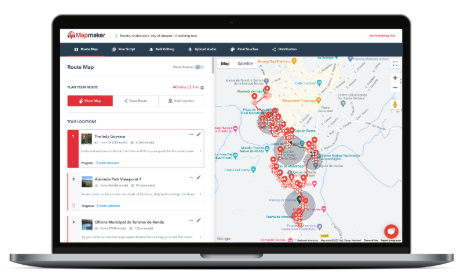
Source: https://voicemap.me/
Pros
- The CMS provides automated talk-time and word-count estimates, reducing the need for repeated field testing and helping creators plan their scripts more efficiently.
- Its mobile app interface is available in 11 major languages (English, Mandarin, German, Spanish, French, Dutch, Portuguese, Italian, Russian, Arabic and Xhosa), making it easy for international travelers to navigate and enjoy content.
- VoiceMap offers OTA reseller listings (Viator, GetYourGuide) at no additional cost for creators on Pro and Premium plans, helping tours reach a wider audience.
- Creators can add text-based directions as a backup, ensuring that users always know where to go even without relying solely on audio cues.
- The browser-based publishing system updates instantly through an API, giving creators real-time control over their content.
- Built-in editorial support from VoiceMap’s editors and sound engineers includes comments, tracked edits, and notifications to guide creators through production.
- Its dashboard gives creators clear insights into tour performance, including monthly downloads, ratings, sales, royalties, listener demographics, and GPS heatmaps—plus easy tools for managing vouchers and payouts.
Cons
- Lacks modern AI-powered features for automation and personalization.
- Not available for Windows Phone users.
- Does not offer tailored tour suggestions based on individual visitor interests.
- The CMS has no native translation feature. Creators must manage translations manually or purchase translation support from the VoiceMap team.
8) PocketSights
PocketSights is a highly adaptable digital tour guide platform designed for organizations such as downtown associations, visitor centers, universities, tourism boards, non-profits, and local businesses. The platform makes it easy to create custom GPS-powered tour routes that guide visitors from one point of interest to another—without being limited to traditional roads or pathways. Tour creators can design routes that explore alleyways, waterfronts, gardens, off-road areas, and even bodies of water, making it ideal for both urban and outdoor experiences.
Through the PocketSights Tour Builder, organizations can add rich multimedia content, track visitor interactions, collect data, and even incorporate local advertising for added revenue. With features like virtual beacons, donation buttons, mailing list integration, and social sharing tools, the platform helps organizations engage visitors long after the tour ends. This tour guide solution also offers complete customization of the tour completion message, providing an opportunity to deliver personalized parting words and calls to action.
Enterprise users can also benefit from advanced analytics, multi-user collaboration, scalable infrastructure for large events, and the option to launch a white-label mobile app on the App Store and Google Play—fully customized to match their branding. Organizations also benefit from priority tour approval, where the PocketSights team provides expedited reviews to ensure quality control and rapid deployment.
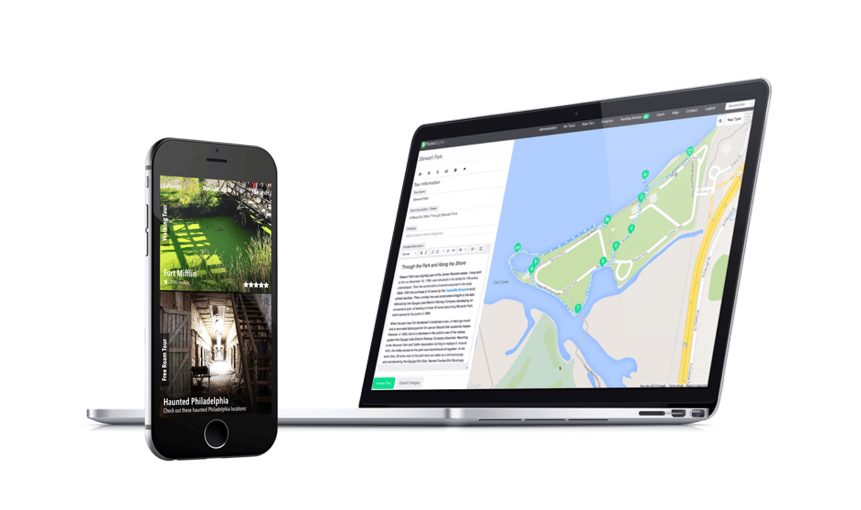
Source: https://pocketsights.com/
Pros
- The mobile app guides visitors through custom routes that are not limited to streets or major paths. Points of interest can be placed anywhere—even parks, forests, gardens, shorelines, or business districts.
- Tour creators can add text, images, click-to-call links, social sharing buttons, custom hashtags, and allow visitors to comment or upload photos.
- Enterprise accounts access detailed insights such as tour views, places visited, virtual tour usage, average visit duration, peak days/times, route patterns, and completion rates.
- Organizations can add multiple team members to manage tours, analyze performance, or edit content together and feature local shops, restaurants, and businesses in their tours, creating a new revenue stream.
- Creators can enable donation buttons and email list sign-ups at the end of tours, helping build long-term connections with visitors.
- Organizations can launch their own branded tour apps on both iOS and Android, with full access to enterprise-level features.
- Non-physical “virtual beacons” can notify visitors about events, attractions, special offers, or nearby points of interest via text-to-speech pop-ups.
Cons
- The platform does not currently include AI-driven personalization, automatic route planning, or AI tour assistants.
- Incompatible with Windows phones.
- Key features like analytics, local advertising, white-label apps, virtual beacons, and advanced visitor engagement require an Enterprise plan. Free/basic accounts lack these; enterprise is designed for organizations (CVBs, visitor centers, universities, non-profits) needing commercial use, data collection, donations, and scalability.
General Comparison
|
App |
Founded in |
Total number of destinations |
Number of languages supported |
Compatibility |
Installation |
AI-powered |
|
SmartGuide |
2018 |
1500+ |
102 |
Google Play Store, App Store |
Free |
✔ |
|
izi. Travel |
2011 |
2500+ |
70 |
Google Play Store, App Store, |
Free |
✖ |
|
GuidePal |
2012 |
NA |
NA |
Google Play Store, App Store |
Free |
✖ |
|
Tourient |
NA |
NA |
64+ |
Google Play Store, App Store |
Free |
✖ |
|
StoryHunt |
2018 |
16 |
2 |
Google Play Store, App Store |
Free |
✔ |
|
STQRY |
2012 |
NA |
50+ |
Google Play Store, App Store |
Free |
✔ |
|
VoiceMap |
2014 |
600+ |
11 |
Google Play Store, App Store |
Free |
✖ |
|
PocketSights |
2019 |
NA |
NA |
Google Play Store, App Store |
Free |
✖ |
Where should you publish your guide in 2026?
The landscape of digital tourism continues to grow rapidly, offering destinations and creators more powerful tools than ever before. Each tour guide platform featured in this article provides its own strengths—whether through advanced analytics, user-friendly CMS features, multilingual support, AR/AI enhancements, or flexible monetization options. However, the right choice ultimately depends on your goals: reach, storytelling style, technical needs, and desired visitor engagement.
Flexible, AI-powered audio guide platforms like SmartGuide make it easier for destinations, attractions, and tourism businesses to deliver meaningful, interactive, and sustainable visitor experiences. By choosing the right publishing platform, you can amplify your stories, improve accessibility, and connect with modern travelers in ways traditional tools simply can’t match.
Ready to boost your visitor experience with smart multimedia guides? Contact us today and start creating your digital guide with ease.